
That Doesn’t Seem Right: 4 Common Bra Fitting Myths We Hear Every Day
- Angela O'Brien

- 21 hours ago
- 6 min read
“You need a white bra, a black bra, and a nude bra.”
“Your shoulder straps should be as tight as possible because that gives you lift.”
“If your bra leaves red marks, it must be hurting you.”
We hear versions of these bra fitting myths in the change room all the time.
Most women are not making these things up. They have heard them from mothers, grandmothers, friends, relatives, and well-meaning strangers for years. So, when they come into a lingerie boutique, they often bring a mental checklist of bra “rules” with them.
The problem is that many of those rules are not really rules at all. Some are outdated. Some are misunderstood. Some were never true in the first place.
At Esteem Lingerie in West Kelowna, our professional bra fitters help women sort out what is true, what is helpful, and what might be keeping them from finding a bra that actually fits.
Here are four common bra fitting myths we hear every day.
Myth 1: A Comfortable Bra Should Feel Like I am Wearing Nothing
We understand why women worry about a bra band feeling too tight. Nobody wants to feel squeezed, restricted, or uncomfortable around the ribcage.
But a supportive bra band is not supposed to feel loose. A correctly fitted bra needs some tension in order to create support for the breasts. This is called anchoring the bra.
A properly fitted bra band should feel like a snug hug. It should be firm enough to stay in place and support you, but not so tight that it causes pain, pinching, bruising, or trouble breathing.
One of the most common fitting issues we see is a band that is too loose. When the band is too loose, it will slide up your back, shift during the day, and leave your breasts feeling unsupported. Sometimes the breast will slip under the band when you lift your arms up.
The band is the foundation of the bra. It does most of the support work.
Light red marks at the end of the day are not always a sign that your bra is too tight. Think about the waistband of your pants or underwear. If something sits against your body for hours, it may leave a temporary mark.
That said, your bra should not hurt. Deep marks, rubbing, bruising, pinching, or skin irritation are signs that the fit needs to be checked.
A good bra should feel secure, supportive, and wearable. Not invisible. Not painful. Somewhere in the middle is usually where the magic happens.
Myth 2: Tight Straps Give You Better Lift
This is one of the biggest bra fitting myths we hear.
Many women tighten their shoulder straps as much as possible because they think straps are responsible for lift and support. It seems logical. If the breasts feel low, pull the straps tighter.
But that is not how a bra is designed to work.
Most of your bra support should come from the band, not the shoulder straps. The straps help with cup positioning and smoothing, but they are not meant to do the heavy lifting.
When straps are doing too much work, they can dig into your shoulders, pull the band up your back, and make the whole bra feel uncomfortable. Often women try to increase support by tightening the shoulder straps, but that usually creates a whole new set of issues.
If your straps keep falling down or feel loose, do not tighten them right away. First, check the band. Has it started riding up? Is it sitting level around your body? Is it on the right set of hooks?
Tightening the straps to stop them from slipping off of the shoulders is counter productive. As the straps are tightened, the back is pulled up, which in turns loosen the straps even more.
As a bra stretches with wear, the band may need to be adjusted to the next set of hooks. Once the band is sitting firmly and level again, then you can make a small strap adjustment if needed.
The band has a job. The straps have a job. When both are doing the right job, the whole bra works better.
Myth 3: T-Shirt Bras Are Always the Best Choice
T-shirt bras are very popular, and for good reason. They can give a smooth look under thinner tops, some fitted clothing, or simple everyday outfits.
But a t-shirt bra is not automatically the best bra for every body, or every piece of clothing.
Many t-shirt bras have molded cups. That means the cup has a pre-formed shape. If your breast shape works well with that form, wonderful. If it does not, the bra may gap, press, flatten, or push breast tissue in a direction that does not feel quite right.
This is where seamed bras can surprise people.
Seams are not just decorative. They help shape, lift, and support the breast tissue. A cut-and-sewn bra with seams can often bring the breast tissue forward, create better projection, and give a more lifted shape. Structured clothing with darts often fit better with a seamed bra versus a seamless t-shirt style bra.
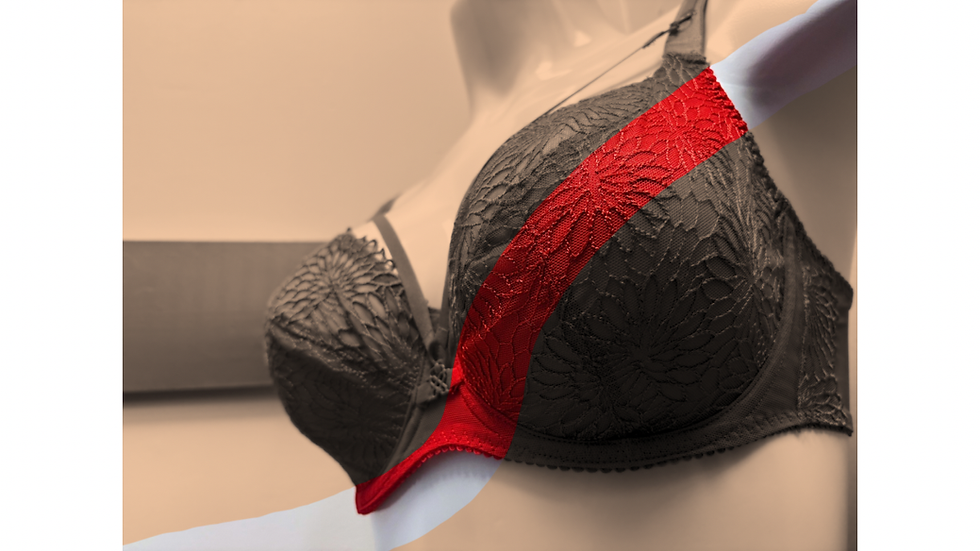
Lace can also have a purpose. Depending on the bra, lace and fabric panels can help the cup adjust more naturally to your shape than a molded cup.
This does not mean you need to give up your favourite t-shirt bra. It simply means it may not be the only style worth trying.
If you have always worn molded t-shirt bras and still feel like something is not quite right, a professional bra fitting can help you compare styles. Sometimes the bra you were avoiding because of seams or lace is the one that gives you the shape, comfort, and support you were trying to find.
Myth 4: Underwire Bras Are Bad for You
Let’s clear this up.
Underwire bras do not cause breast cancer. There is no reliable scientific evidence showing a link between wearing an underwire bra, or any kind of bra, and developing breast cancer. (Canadian Cancer Society) https://cancer.ca/en/cancer-information/reduce-your-risk/myths-and-controversies/does-wearing-a-bra-increase-my-risk-of-breast-cancer
That does not mean every underwire bra will feel good on every body.
An underwire bra needs to be fit properly. The wire should sit around the breast tissue, not on top of it (we have a natural crease in our body under the breast). It should not poke, dig, shift, or press into sensitive areas. All breast tissue should be in the cup. The underwire needs to sit behind the breast on the side of the body
When a wired bra hurts, the issue is usually not the wire itself. The issue is often the size, shape, style, or placement of the wire.
A well-fitted underwire bra can give excellent lift, separation, and support. It can also help avoid the compressed “mono-boob” shape that some women dislike in softer or poorly structured bras.
We often see women avoid underwire because they once had a bad experience with a bra that did not fit. That is completely understandable. One poking, digging, miserable bra can turn anyone off wires for years.
But the right underwire, in the right size and style, can feel very different.
The goal is not to force every woman into an underwire bra. The goal is to help you understand your options so you can choose what works for your body, your comfort, and your wardrobe.
When should I get a professional bra fitting?
A professional bra fitting can help you understand what support should actually feel like.
You may benefit from a fitting if:
Your bra band rides up your back.
Your shoulder straps dig in or constantly fall down.
Your cups gap, wrinkle, or overflow.
Your underwire pokes, presses, or sits on breast tissue.
Your bra feels fine in the morning but uncomfortable by the afternoon.
You feel unsupported, compressed, or wider than you want to look.
You have been buying the same size for years, but something no longer feels right.
Bodies change. Bras stretch. Styles fit differently. A size that worked before may not be the best fit now.
A properly fitted bra should not feel like a mystery.
It should feel supportive, secure, and right for you.
Ready to Find a Bra That Fits Properly?
If you are not sure whether your bra is fitting the way it should, visit Esteem Lingerie in West Kelowna for a professional bra fitting.
At Esteem Lingerie in West Kelowna, we help women find bras that support their shape, their comfort, and their everyday life. We also help clear up the fitting-room myths that can make bra shopping more frustrating than it needs to be.
We will help you understand what support should feel like, what is normal, and what might be a sign that it is time for a better fit.
Frequently Asked Questions About Bra Fitting
Should a bra band feel snug?
Yes. A properly fitted bra band should feel snug and secure, like a firm hug. It should not ride up your back, but it also should not cause pain, pinching, or restriction.
Do bra straps provide most of the lift?
No. Most bra support should come from the band. Shoulder straps help with cup positioning and smoothing, but they should not be tightened so much that they dig into your shoulders.
Are t-shirt bras the best choice for everyone?
Not always. T-shirt bras are useful when you want a smooth look under clothing, but seamed or lace bras may provide better lift, shape, and support depending on your breast shape.
Do underwire bras cause breast cancer?
No. There is no reliable scientific evidence showing that underwire bras, or any other kind of bra, cause breast cancer. A poorly fitted underwire can cause discomfort, but the issue is usually the fit, not the wire itself.


Comments